

Peak Power Solar now supplies the SolarSense 750, Victron Energy’s wireless standalone PV-installation monitor, as an authorized Victron distributor in Nepal.
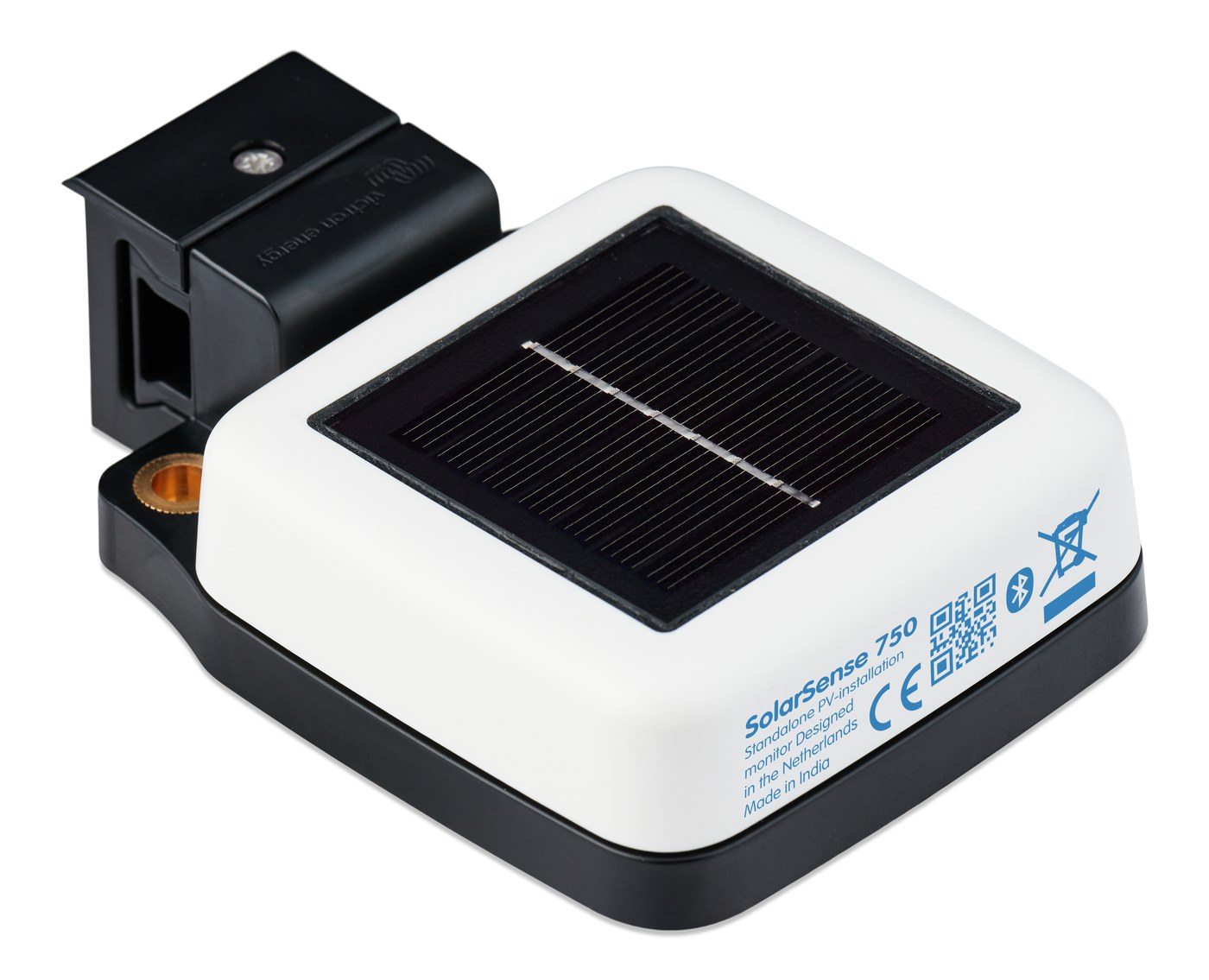
The SolarSense 750 is a small, fully self-powered sensor — it has its own integrated solar cell and rechargeable internal battery, so there’s no wiring or external power needed. It clips onto the frame of a solar panel using a supplied mounting bracket and communicates wirelessly over Bluetooth Low Energy (Instant Readout), reporting straight to VictronConnect or, when in range, to a GX device and onward to the VRM Portal alongside the rest of a system’s monitoring data.
Why an independent sensor matters for monitoring
Most system monitoring only tells you what the inverter and charge controllers measured after the fact — actual power delivered, actual state of charge. What it can’t tell you on its own is whether that output is actually good for the conditions on a given day. The SolarSense 750 fills that gap by measuring solar irradiance directly at the panel, plus cell temperature, and calculating an estimated available solar power independent of what the rest of the system is doing with it.
Having that independent, measured reference is genuinely useful once a system has been running for a while:
- Historical trend analysis. The sensor stores 31 days of irradiance, estimated power, and temperature trends, plus 730 days (two years) of daily history — daily max irradiance, min/max estimated power, min/max temperature, and daily estimated yield — so performance can be tracked over seasons, not just days.
- Array performance vs. real measured irradiance. Because the sensor reports actual measured sunlight hitting the panel, not just what the inverter produced, it becomes possible to tell the difference between “the sun wasn’t out much today” and “the array is underperforming for the irradiance it actually received” — the kind of comparison that catches soiling, shading, degradation, or wiring faults early, rather than after yield has quietly dropped for months.
- Curtailment and load-planning decisions. In off-grid or grid-limited systems where excess PV is wasted once batteries are full, knowing exactly how much solar power is available in real time makes it possible to divert that surplus to water heating or other loads instead of losing it.
Installation is simple — the bracket mounts to the side of the panel frame with two self-drilling screws, the sensor slides in and locks with a single screw, and it’s rated IP65 for outdoor use across a -40°C to +85°C range. There’s no cabling to run, which makes it practical to add to existing installations, not just new ones.
For the kind of remote, hard-to-access sites Peak Power works on across Nepal, that combination — no wiring, weatherproof, and a genuine independent reference for comparison — makes the SolarSense 750 a useful addition wherever ongoing performance monitoring matters as much as the initial install.
Get in touch with Peak Power to add SolarSense monitoring to a new or existing system.